

New Project "Decolonial Epistemologies?"
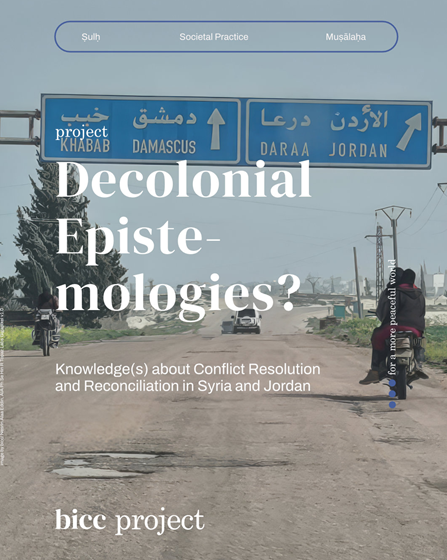
How do societies know how to resolve conflict and reconcile? Which forms of knowledge shape local conflict resolution beyond formal legal systems? This project by the Bonn International Centre for Conflict Studies investigates these questions by historicising knowledge(s) about ṣulḥ and muṣālaḥa—widely practiced forms of societal conflict resolution and reconciliation in the Middle East—as sites of epistemological inquiry in southern Syria and northern Jordan.
This project explores ṣulḥ and muṣālaḥa, long-standing societal practices of conflict in Syria, Jordan and the wider Middle East, not only as social rituals but as fields of knowledge shaped by history and power. Drawing on decolonial theory, it traces the history of local conflict resolution from pre-colonial times to the present. It asks: Who is recognised as a mediator? How are practices of conflict resolution and reconciliation learned, and which voices in these processes are silenced or preserved?
Combining archival research with long-term comparative ethnography among Syrians and Jordanians, the study traces how concepts, symbols and everyday experiences of conflict resolution are transmitted across generations and borders. By focusing on local actors rather than formal institutions, it highlights vernacular and experiential forms of knowing that often remain invisible in academic epistemology, or theories of knowledge. The comparison between southern Syria and northern Jordan—regions historically intertwined yet politically separated since the drawing of colonial borders—offers a unique lens through which to analyse how differing regimes intersect with local understandings of justice and repair. Ultimately, the project seeks to rethink conflict resolution as a window into emerging Middle Eastern epistemologies and to bridge debates in Peace and Conflict Studies, the anthropology of knowledge and decolonial scholarship.